
A Sri Lanka safari tour brings a different rhythm to an island holiday: elephants grazing beside a reservoir, a crocodile resting at the water’s edge, birds moving between forest and wetland, and perhaps a leopard slipping out of the scrub. Yala, Udawalawe, Wilpattu and the Minneriya area each offer a distinct landscape and suit different routes.
The best experience starts before the jeep leaves. Choose a park that fits your hotels and onward journey, arrange both the safari vehicle and entry permits, and leave room for changing weather and animal movements. This guide follows those decisions in order, with private-jeep prices, photographs and illustrated park guides to help you plan.
Do you need a jeep for a safari in Sri Lanka?
Why a safari jeep is different from your charter car
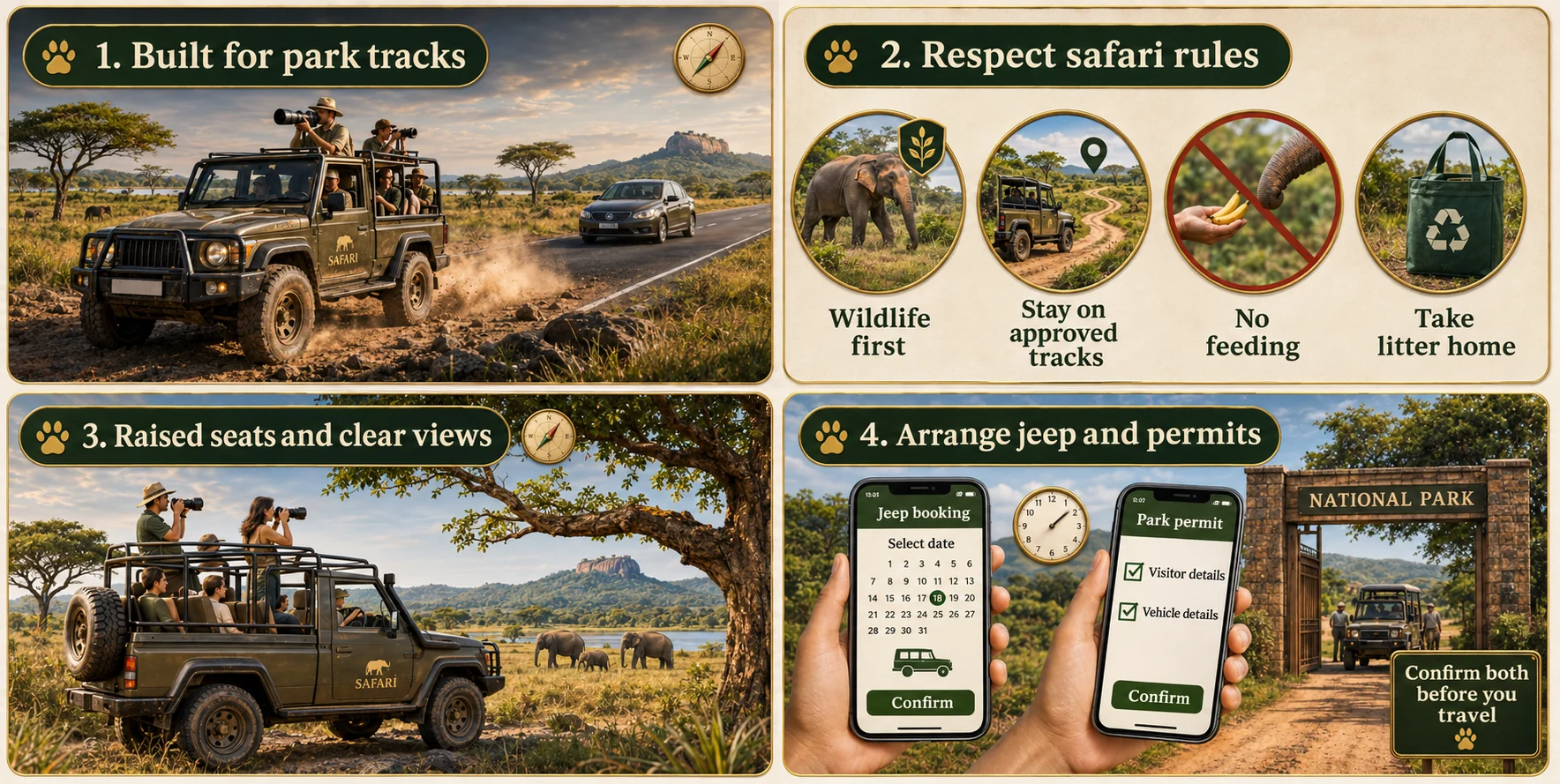
National park tracks can be dusty, uneven and muddy after rain. A safari jeep is suited to these conditions and its raised passenger seats help everyone look across grassland and scrub. Your normal car or van handles the road journey; the safari jeep handles the game drive. It is worth treating them as two different parts of the itinerary.
The vehicle is only part of the decision. Drivers must follow approved routes and local instructions, give wildlife priority and avoid disturbing animals. Staying on designated tracks, keeping rubbish inside the vehicle and never feeding wildlife protect the habitat as well as the quality of the visit. A good safari allows patient observation instead of chasing a particular photograph.
Arrange the park permit as well as the jeep
Booking a jeep and obtaining admission are connected tasks, but they are not automatically the same purchase. The Department of Wildlife Conservation’s online permit service asks for visitor and vehicle details, and applies a permit limit for each park. Once that limit is reached, online reservations close. Check the arrangements in advance, particularly during European school holidays and other busy periods.
If LankaMe coordinates the safari, confirm which park, entry arrangements, collection point and group size are covered by the quotation. If you arrange a jeep independently, check who obtains the permit and what you need to show at the gate. Avoid paying for a second admission ticket when it is already included in your confirmed safari package.
How to book a private Sri Lanka safari jeep tour
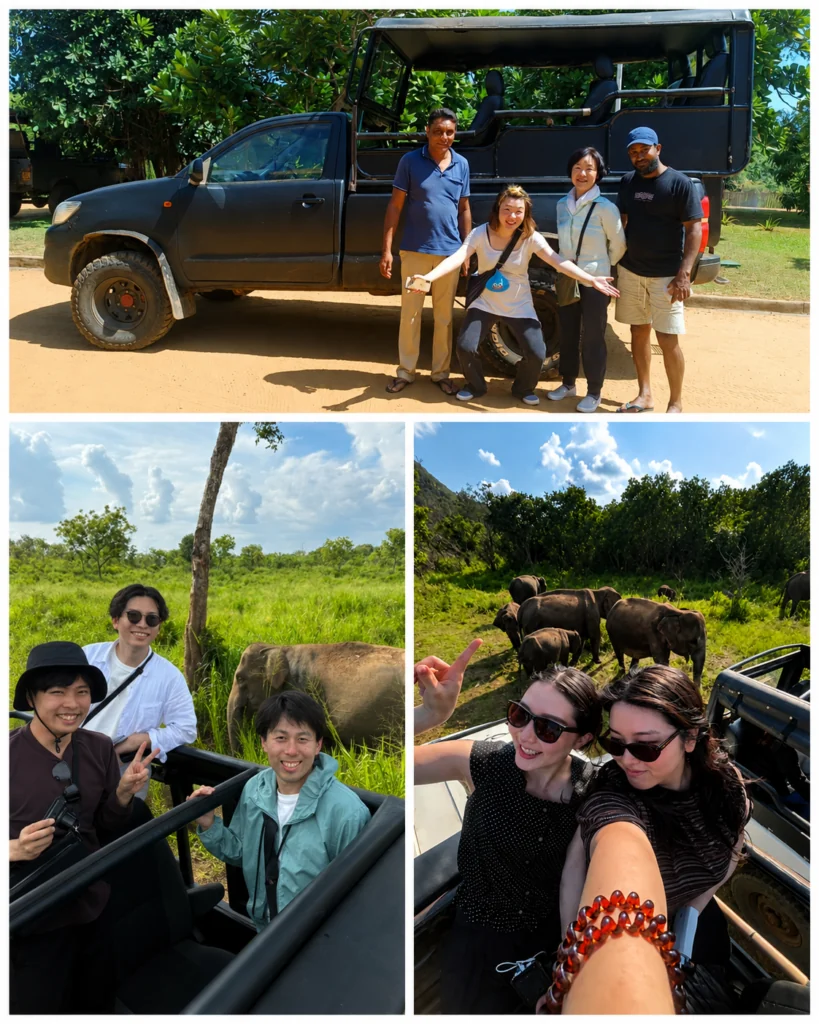
LankaMe can coordinate a private safari through the local driver team as part of your car-and-driver itinerary. The advantage is practical: the jeep, park entry, hotel collection and onward transfer can be planned together. Value depends on those inclusions and the quality of the arrangements, rather than the headline jeep price alone.
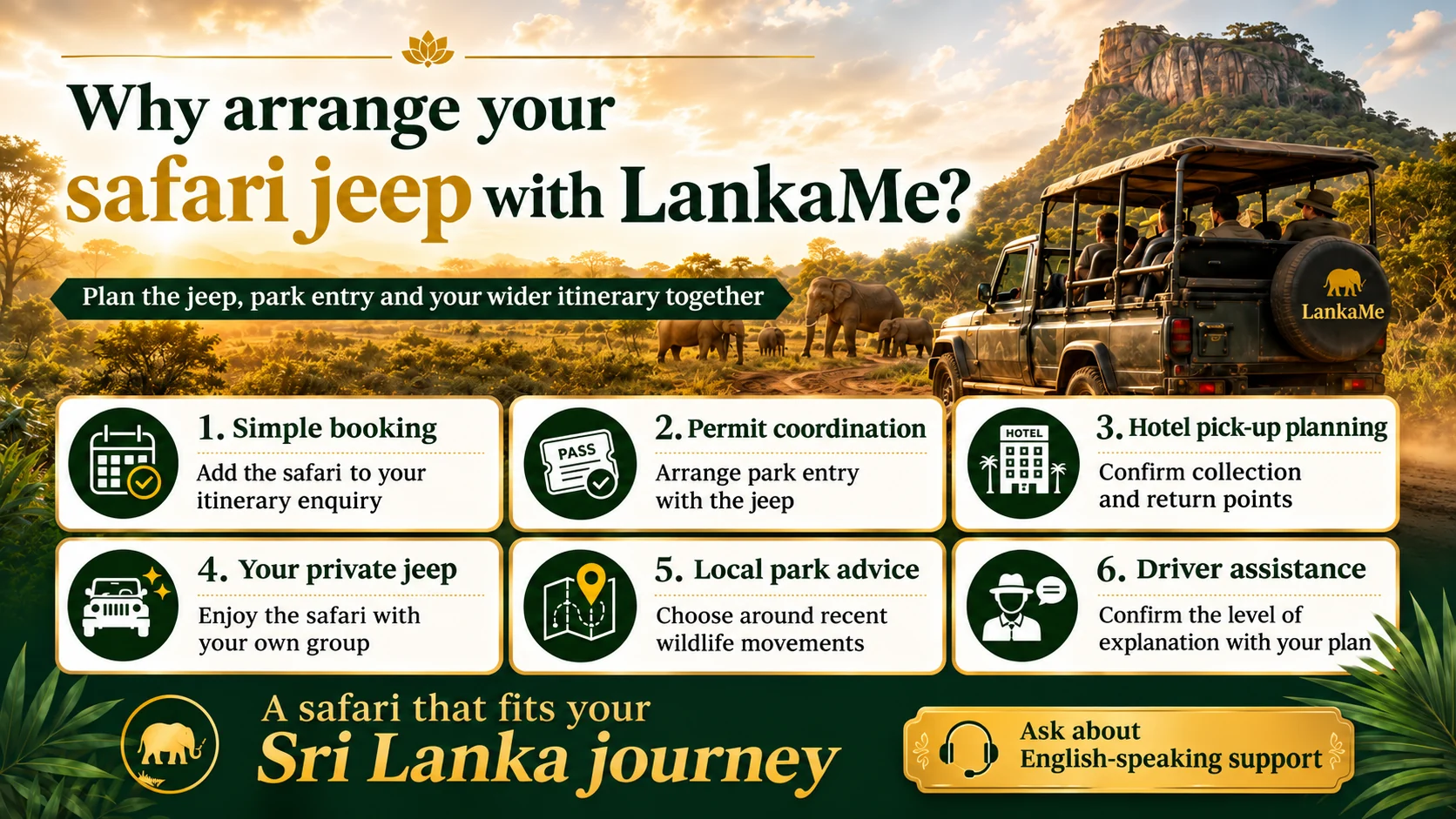
1. Add the safari to the same itinerary enquiry
Tell us your travel dates, hotel areas, number of adults and children, and the animals you hope to see. We can discuss a suitable park and safari duration alongside the wider route. This makes it easier to identify an unrealistic driving day or a collection point that is too far from your accommodation before you confirm.
2. Coordinate permits and entry arrangements
The local driver team can coordinate the jeep and park admission together. The LankaMe guide prices below include entrance fees, so compare the complete arrangement with any jeep-only offer. Your final quotation should identify what is included and any extras; do not assume a permit or a long-distance hotel transfer is part of every advertised safari.
3. Plan hotel pick-up and your next destination
Many ready-made safari products collect only within a specified area. With the safari built into your private-driver route, collection and return points can be discussed in the context of your actual hotel, road conditions and next stop. Confirm the location and timing rather than assuming that any hotel on the island is covered.
4. Enjoy the jeep with your own group
A private jeep is reserved for your party rather than shared with unrelated passengers. This can make the day easier for couples, families and friends who want to enjoy photography or take a quieter pace. Wildlife and park rules still determine where the jeep can stop.
5. Choose the park using recent local information
This matters particularly near Sigiriya. Minneriya, Kaudulla and Hurulu Eco Park form different options for an elephant outing, and the best choice can shift with rainfall, reservoir levels and recent herd movements. A famous park name is a useful starting point, but current local information can be more useful than committing to it months ahead.
6. Confirm driver accompaniment and explanations
Understanding the animals and landscape adds depth to the safari. Your LankaMe travel driver can help coordinate with the jeep driver, and accompaniment or sightseeing explanations can be arranged where included in your selected plan. Confirm the language, level of guiding and availability in advance; a travel driver and a dedicated wildlife naturalist have different roles.
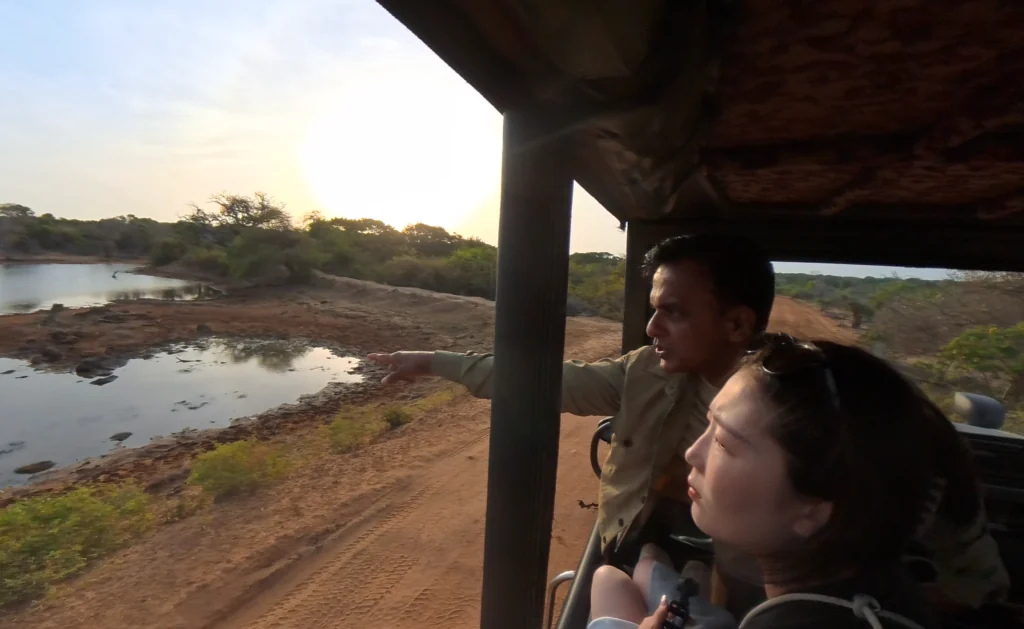
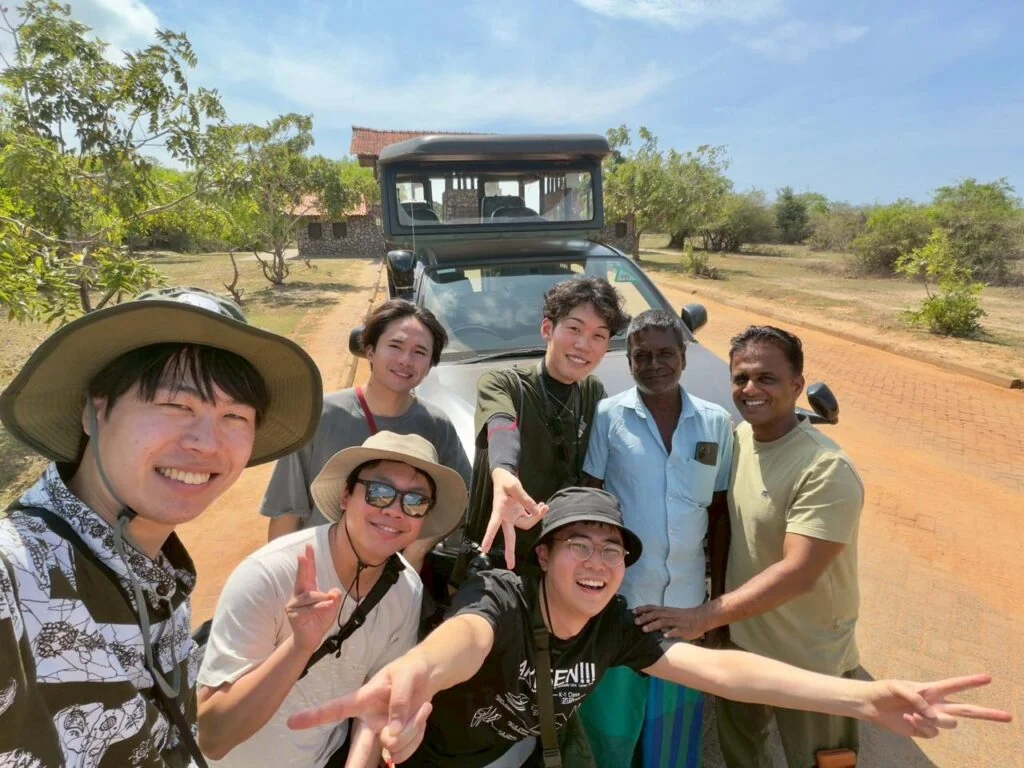
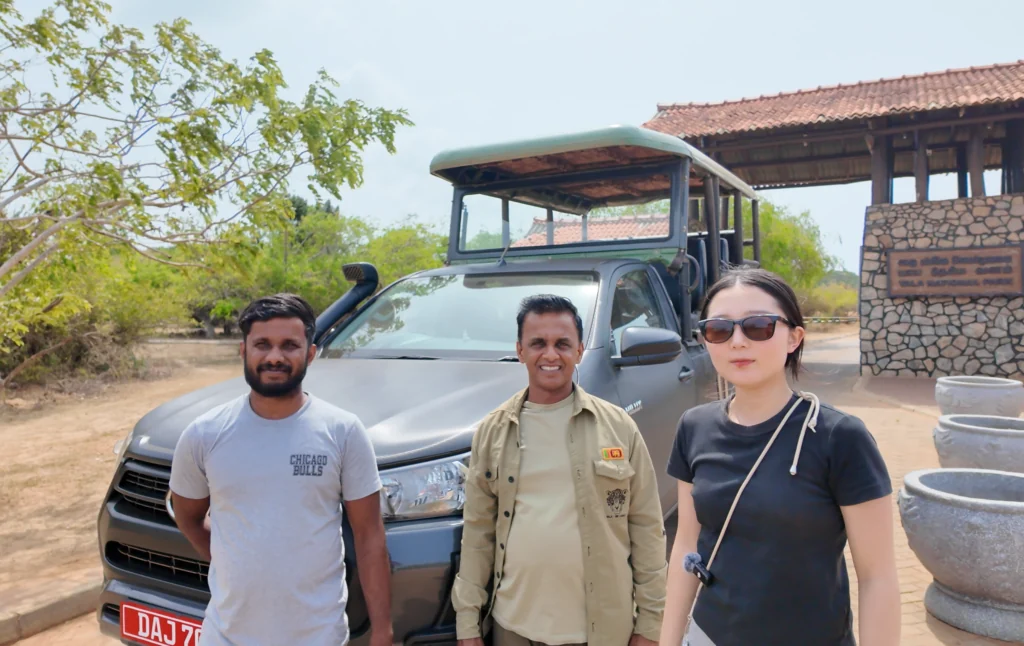
Experienced local jeep drivers bring familiarity with the tracks, recent conditions and respectful viewing positions. The photograph below shows Asanka, a jeep driver used for LankaMe’s Yala arrangements, on the left. The individual driver assigned to a booking depends on availability.
Safari jeep booking options compared
Compare the whole product: a private vehicle or shared seat, admission, collection area, safari duration and the support provided. A low advertised price may cover only one of those elements. The following comparison explains the main differences without changing the LankaMe prices below.
| Booking method | Main advantages | Main disadvantages | Approximate price indication | Pick-up flexibility | Driver support |
|---|---|---|---|---|---|
| LankaMe driver arrangement | Safari can be planned together with the full itinerary; park choice can reflect local conditions. | Best suited for travellers planning a private charter route rather than a one-off ticket only. | Entrance fee + jeep arrangement, quoted according to group size and route. | High, because hotel and onward travel can be considered together. | Easy to coordinate depending on language and plan. |
| Local tour company | Many ready-made products and clear time slots. | Pick-up area, vehicle quality and explanation quality vary by company. | Often sold per person for half-day tours; conditions vary by product. | Medium, depending on pick-up area. | Usually limited unless specifically included. |
| Park entrance or local negotiation | Possible for travellers who want to decide on the spot. | Jeep negotiation, language issues and availability risk remain. | Entrance fees follow the official structure, while jeep cost is separate. | Low to medium. | Usually none. |
| Online booking platform | Easy to compare products, times and cancellation conditions. | Entrance fees may be separate; pick-up rules and inclusions must be checked carefully. | Per-person prices vary widely by park, season and inclusions. | Medium when hotel transfer is included. | Depends on the provider. |
Sri Lanka safari tour prices: private jeep and entrance fees
The following is the current English-site price guide for a private safari arranged through LankaMe. Each amount is the total for the stated group size, not a per-person price. The entrance fee is included. Season, exchange rates, park conditions and the final itinerary can affect a quotation, so confirm the exact amount when enquiring.
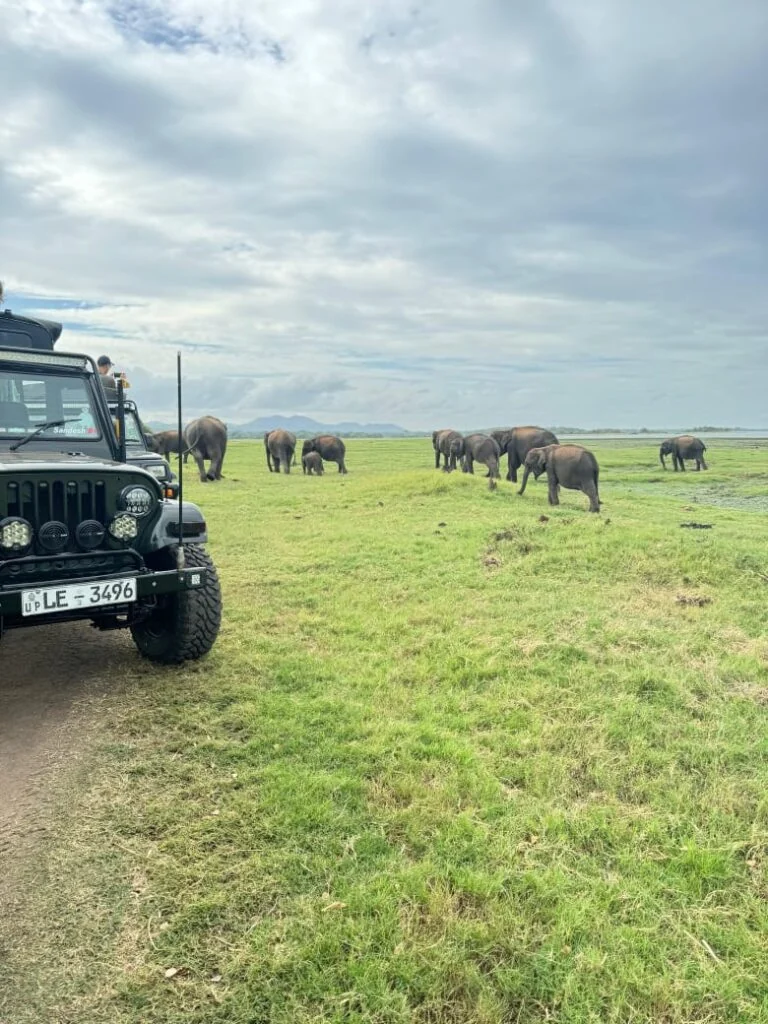
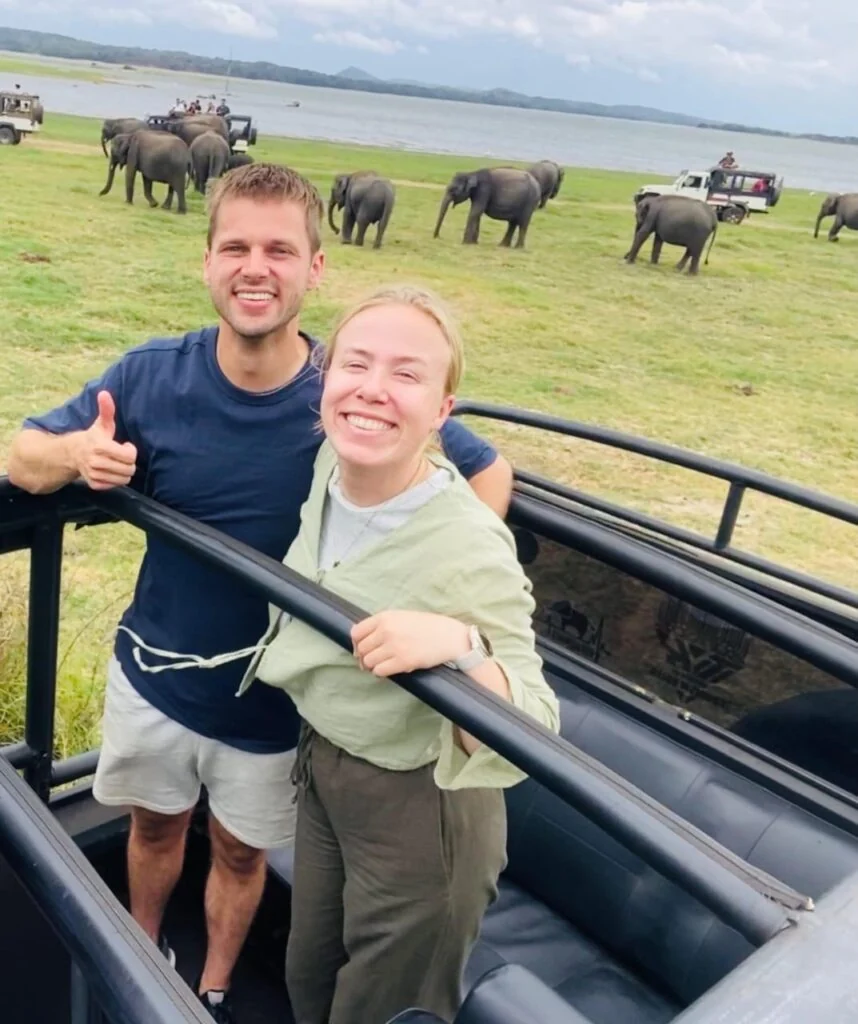
| Safari duration | 1 person | 2 people | 3 people | 4 people | 5 people | 6 people |
|---|---|---|---|---|---|---|
| Half-day safari 3–4 hours | USD 150 | USD 185 | USD 220 | USD 260 | USD 290 | USD 325 |
| Full-day safari 6–8 hours | USD 200 | USD 235 | USD 270 | USD 310 | USD 340 | USD 375 |
A morning safari normally needs a very early hotel departure. A full-day Yala outing often involves setting off around 5–6 a.m., depending on the hotel and entry arrangements. For an afternoon safari, allow enough time for collection, the gate and the game drive before closing. As a planning target, allow for arrival around 2 p.m. for many afternoon outings and by around 3:30 p.m. for Minneriya or Kaudulla; these are not guaranteed official admission deadlines. Confirm the actual schedule locally.
Best national parks for a Sri Lanka wildlife safari
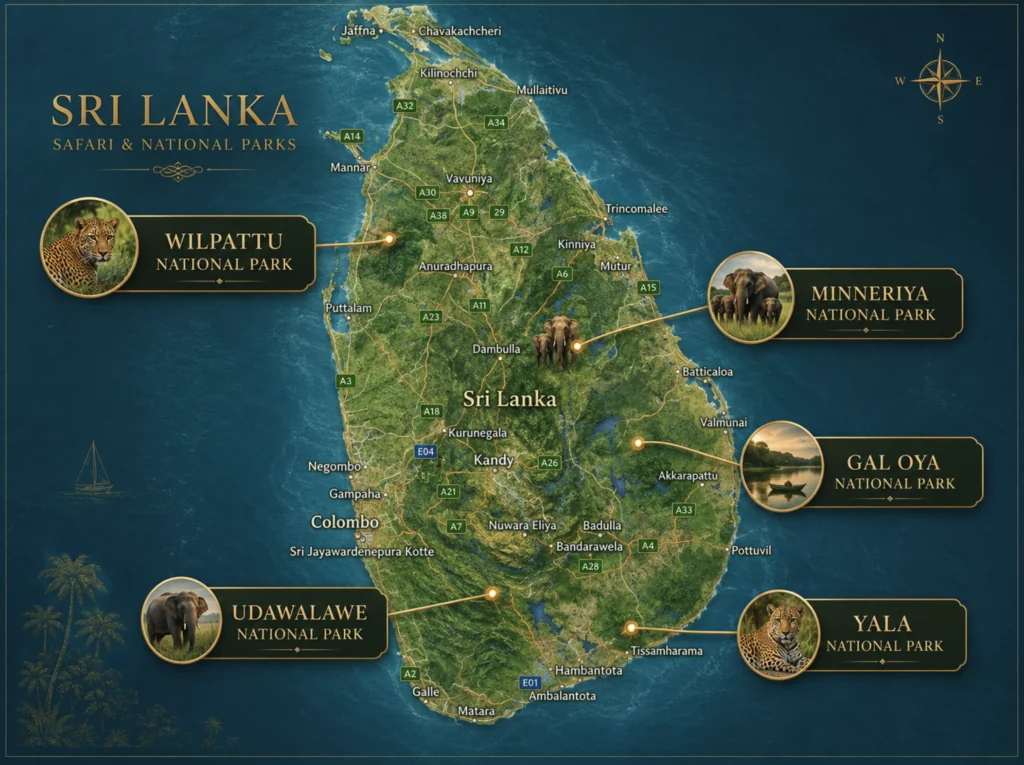
There is no single best safari in Sri Lanka for every visitor. Yala suits a varied wildlife itinerary and leopard hopes; Udawalawe is a strong elephant choice; Wilpattu offers forest and natural lakes; and the Minneriya area fits the Cultural Triangle. Start with your route, then consider wildlife interests, time and local conditions.
| National park | Best for | Typical route fit | Main wildlife appeal | Practical note |
|---|---|---|---|---|
| Yala National Park | First-time safari travellers who want the most famous all-round option. | South coast, Ella, Kataragama or a Colombo-to-south itinerary. | Leopards, elephants, crocodiles, water birds and varied landscapes. | Very popular, so early starts and responsible jeep operation are important. |
| Udawalawe National Park | Travellers who mainly want a strong chance of seeing elephants. | Between the south coast and Ella or the hill country. | Elephant herds, open grassland, birds and reptiles. | Often easier for families because the landscape is open and sightings feel accessible. |
| Wilpattu National Park | Travellers who prefer a quieter, more wilderness-focused safari. | Anuradhapura, Kalpitiya or north-western routes. | Leopards, sloth bears, elephants, water birds and natural villu lakes. | Distances inside the park are longer, so experienced jeep handling matters. |
| Minneriya / Kaudulla / Hurulu Eco Park | Travellers staying near Sigiriya who want an easy elephant safari. | Sigiriya, Dambulla, Habarana and the Cultural Triangle. | Elephants, especially during gathering periods, plus birds and dry-zone wildlife. | The best park can change with recent elephant movement, so local advice is valuable. |
Yala National Park: a safari for leopards and varied landscapes
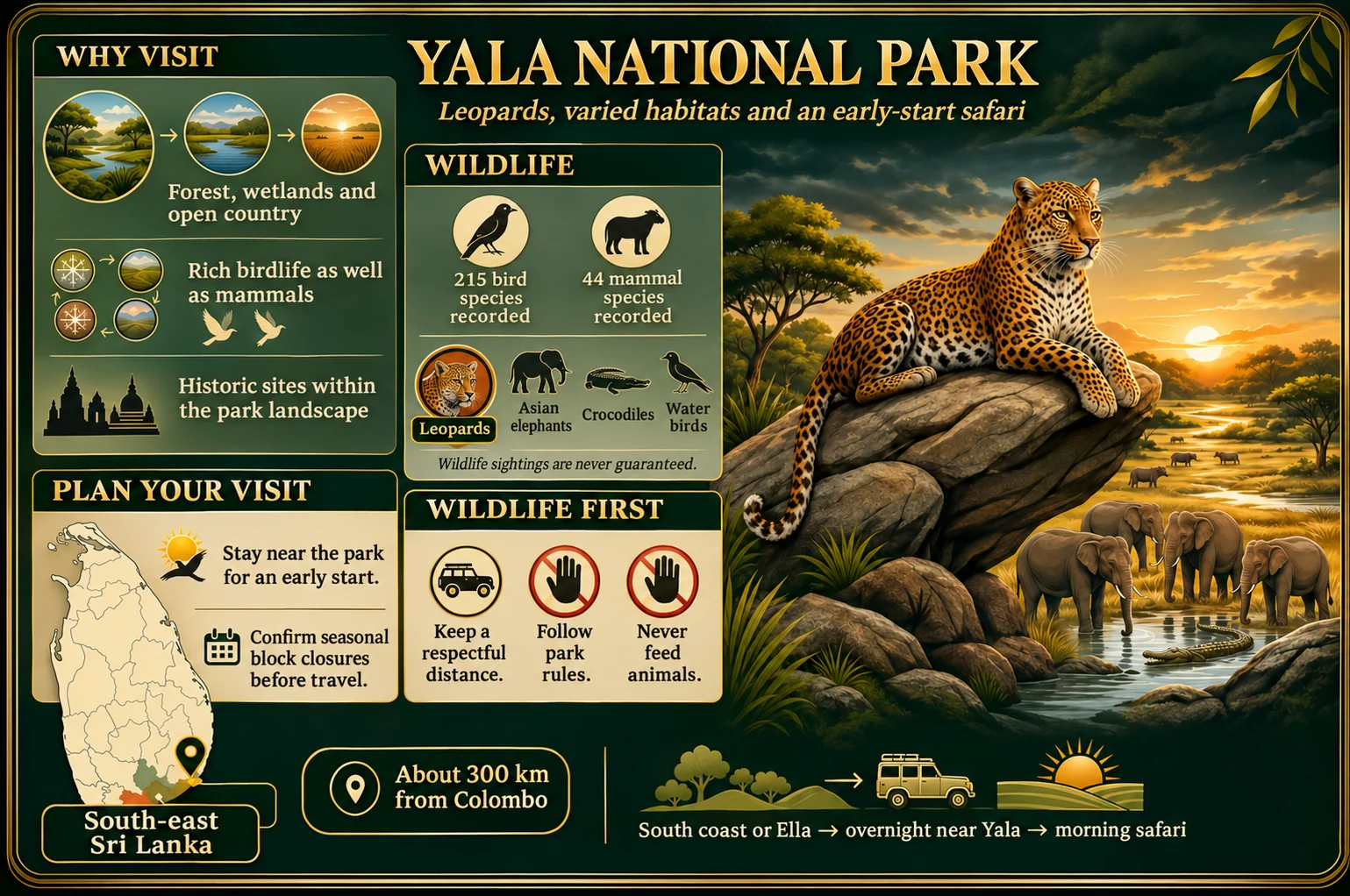
Yala is in south-east Sri Lanka, in Southern and Uva provinces. The mixture of monsoon forest, scrub, open ground and freshwater and coastal wetlands makes it more than a single-species outing. A drive can move from shaded tracks to a waterhole and then to an open view, giving you different subjects even during a short visit.
Leopards are a major attraction: Sri Lanka Tourism describes Yala as having one of the world’s higher leopard densities. That does not translate into a guaranteed sighting. A leopard may be hidden in dense cover, active away from visitor tracks or simply not visible during your drive. Go with interest in the wider ecosystem and the day remains rewarding when a big cat does not appear.
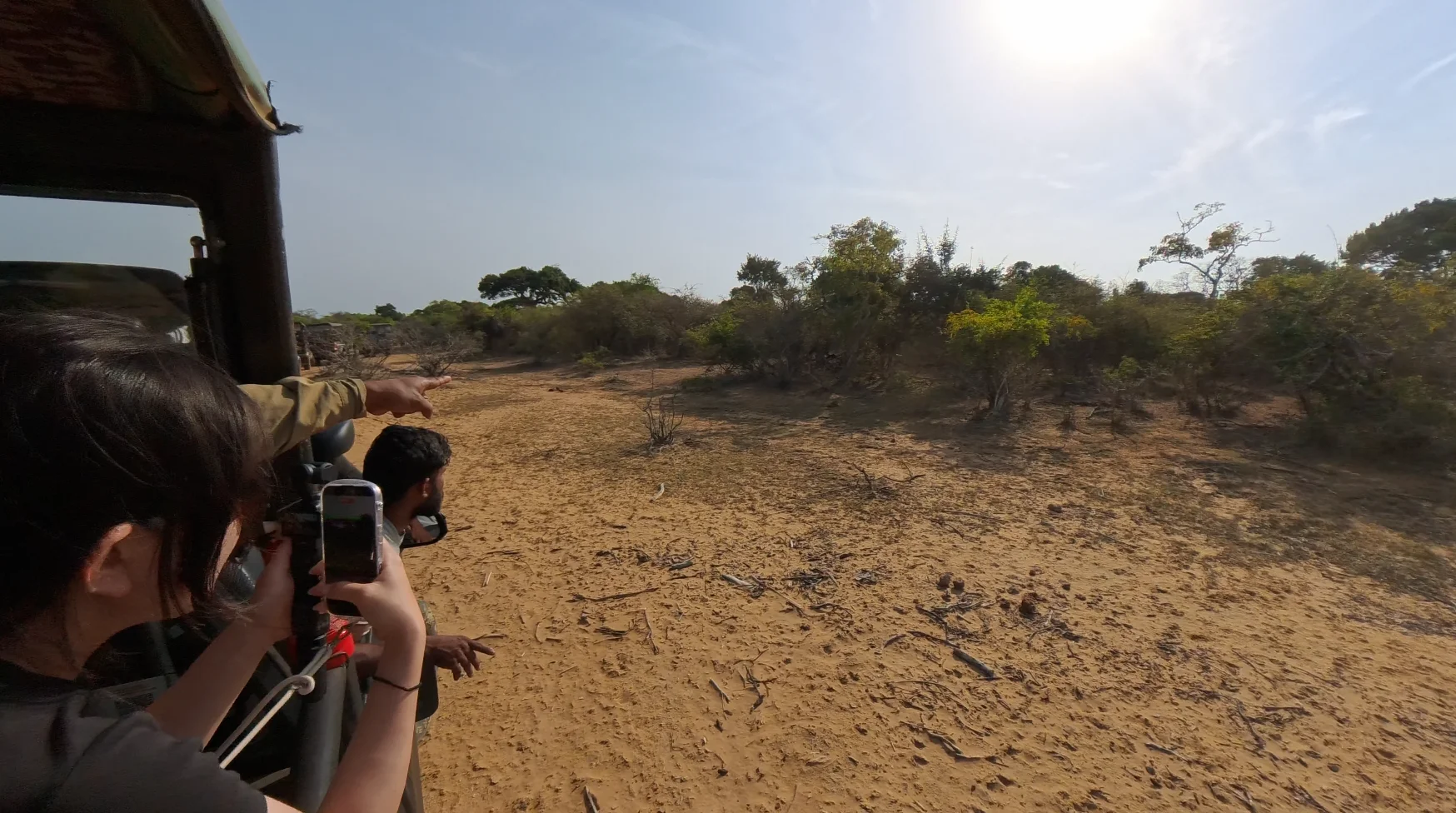
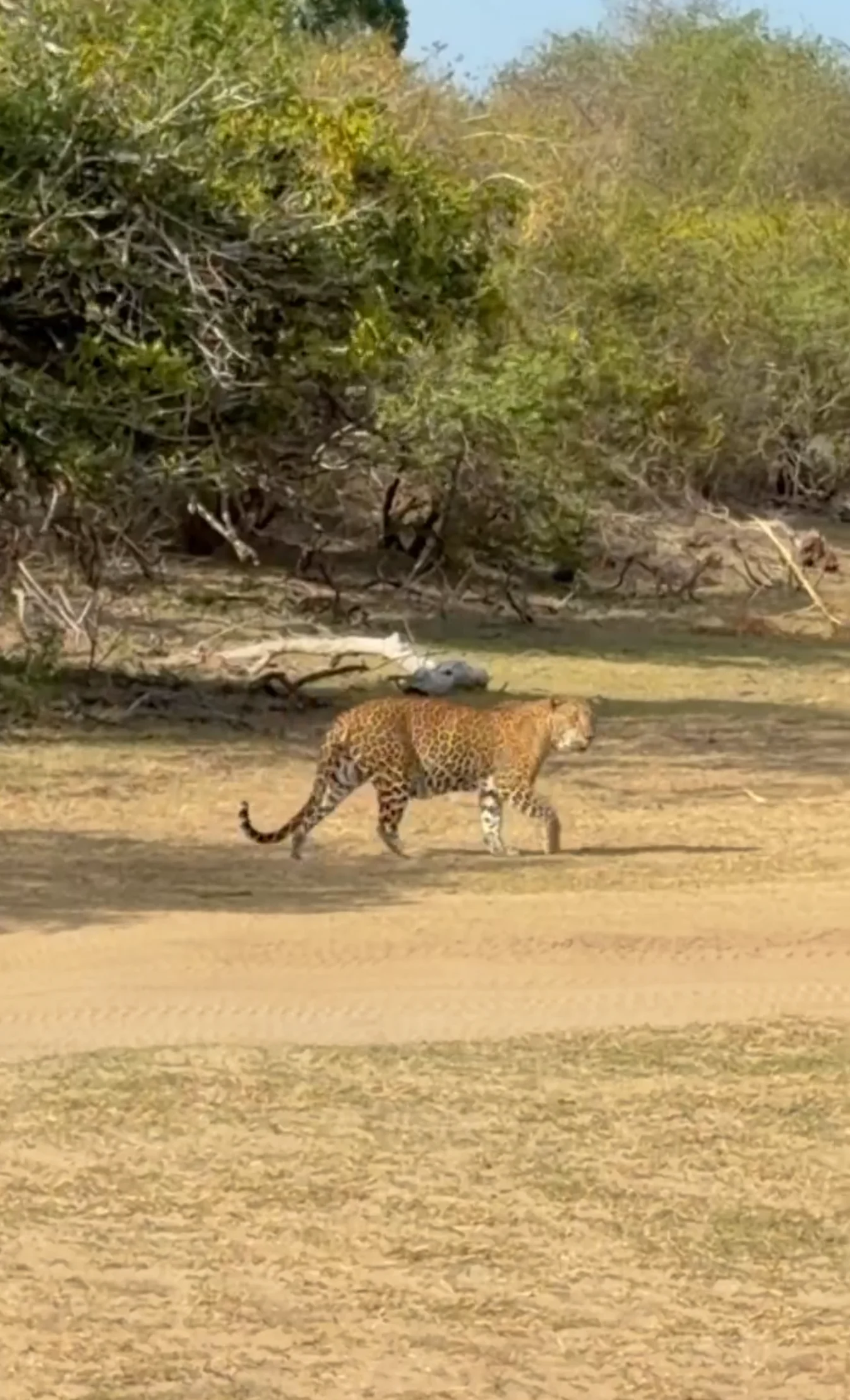
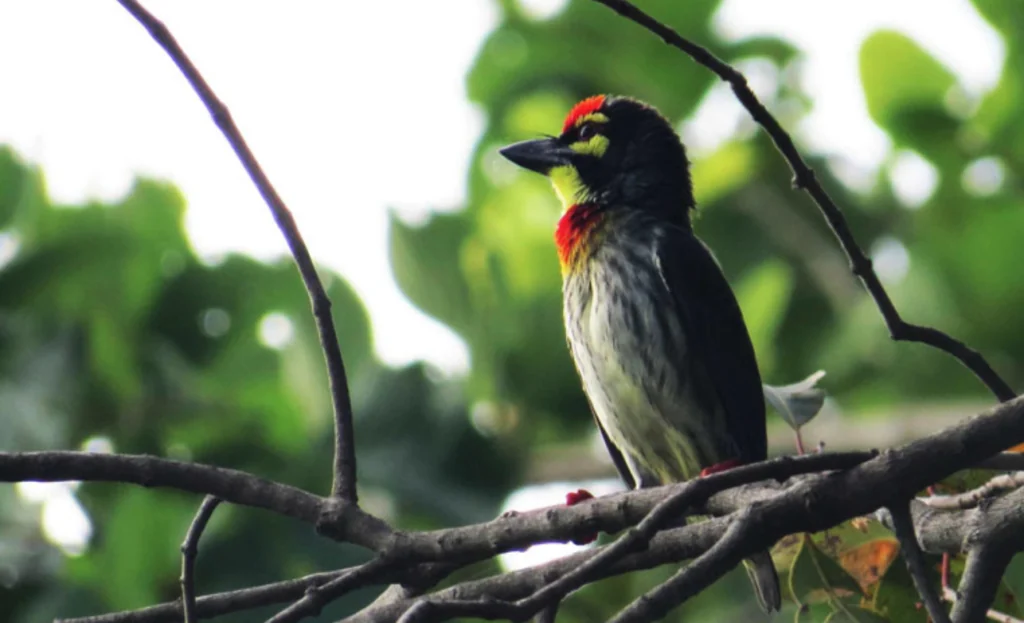
Elephants, deer, crocodiles and birds are part of that wider appeal. Sri Lanka Tourism records 215 bird species and 44 mammal species, and identifies Yala as an Important Bird Area. Birdwatching adds another focus during the quieter stretches between mammal sightings: look around water, tree branches and the edges of clearings rather than watching only the road.
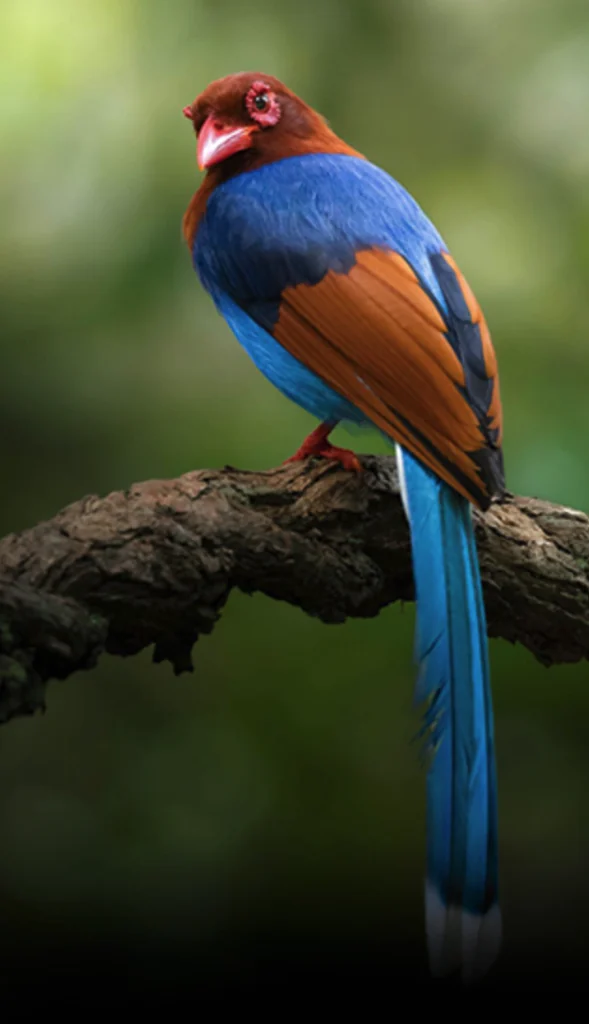
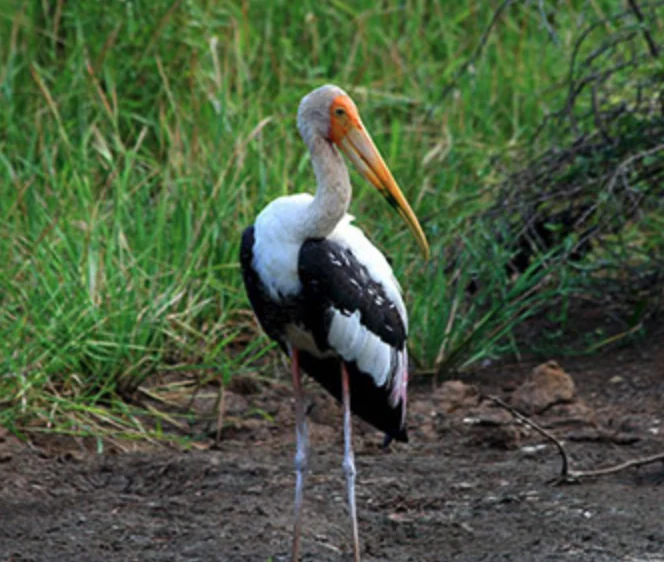
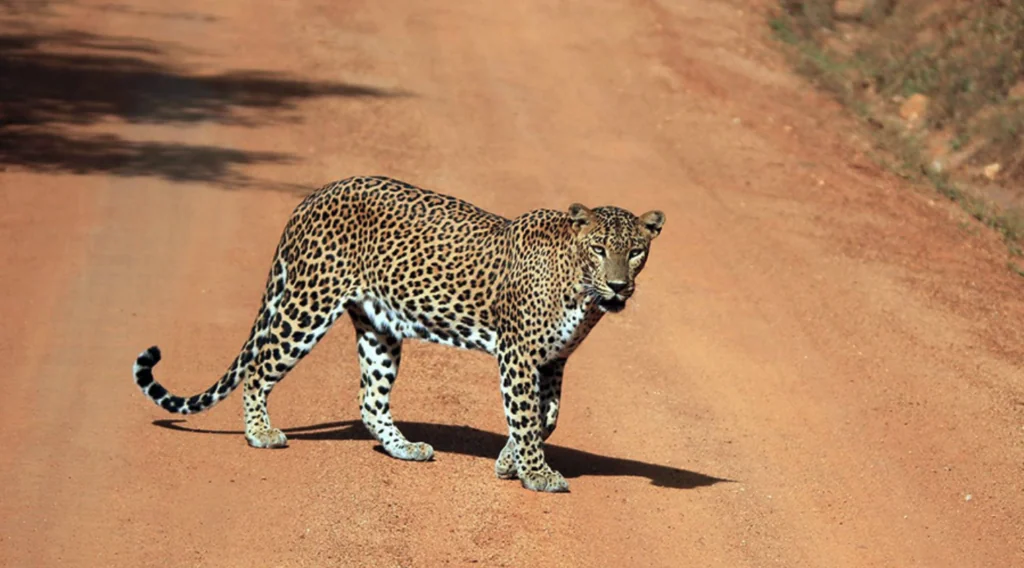
The Yala landscape also has a human history, with ancient sites including Sithulpahuwa and Magul Vihara within the wider park area. They help explain how nature and cultural history overlap here. A standard game drive is not automatically a temple visit; discuss any separate stop when planning the route.
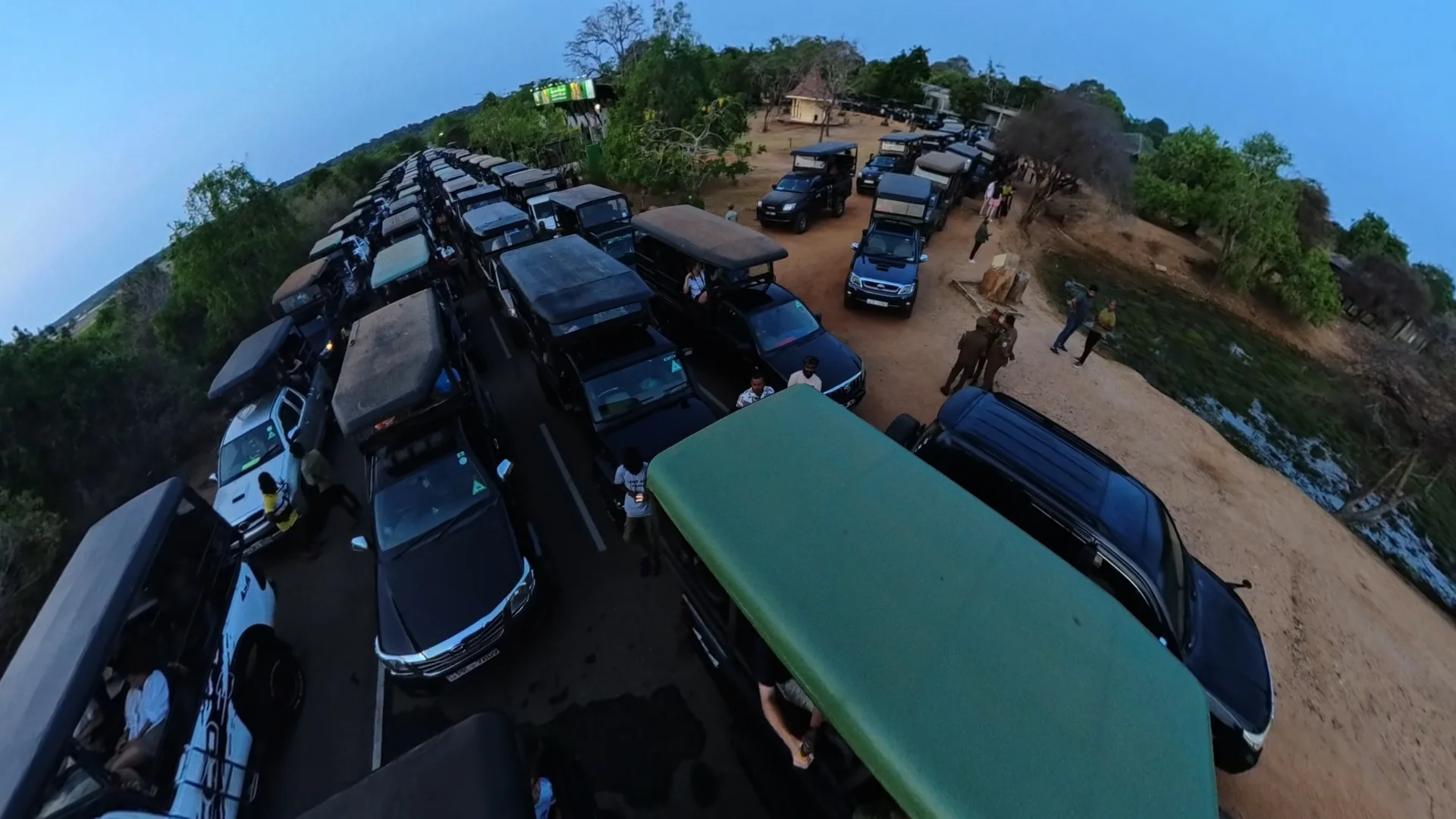
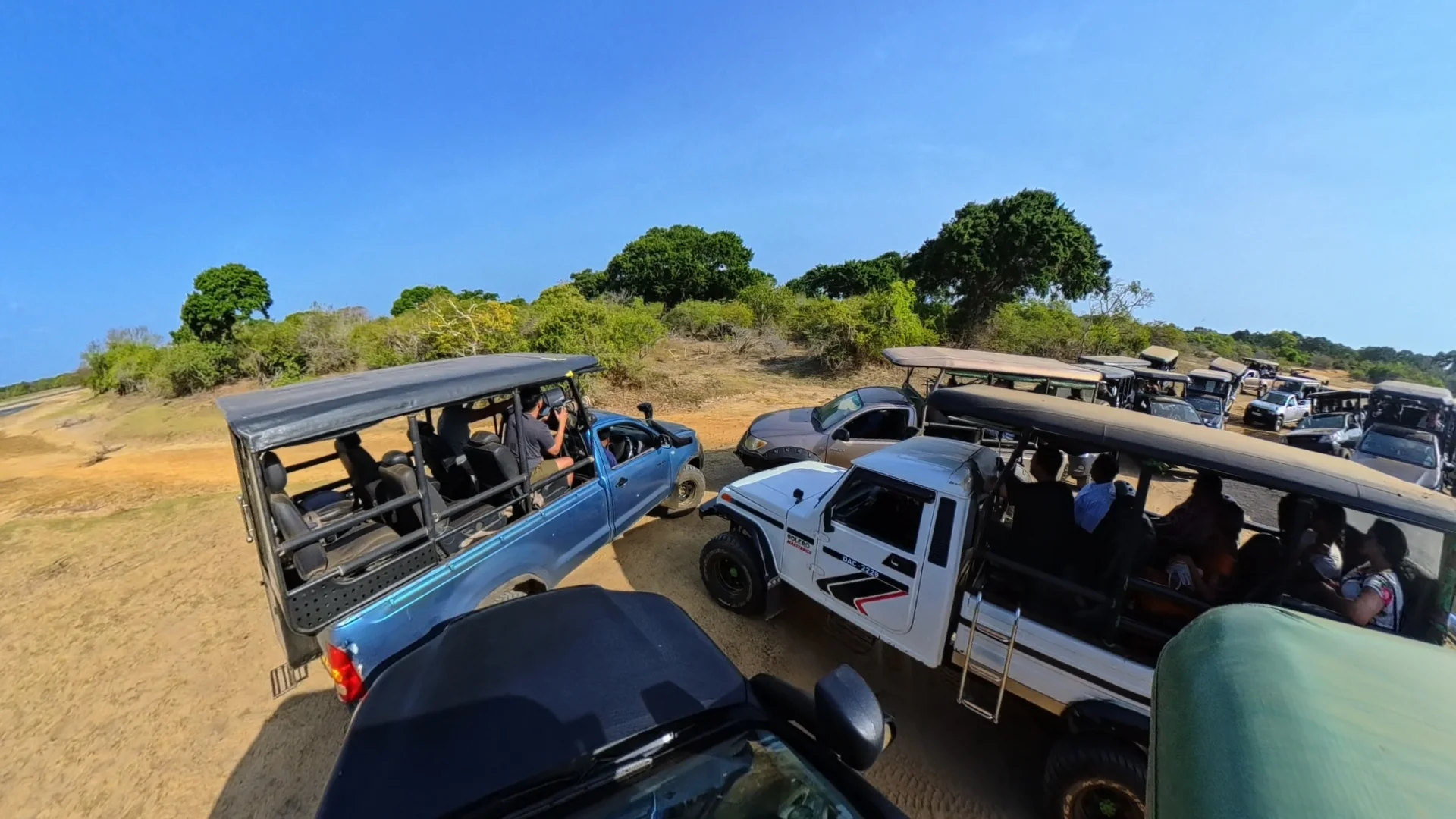
Yala is popular, and vehicles can gather around an animal. Ask for patient driving and enough space for wildlife to move, rather than a rush to the front of a queue. The most useful question is how the operator behaves at a sighting, not whether it advertises a guaranteed leopard photograph.
Getting to Yala from Colombo, the south coast or Ella
Sri Lanka Tourism places Yala roughly 300 km from Colombo, although the actual road distance depends on the park entrance and route. For most multi-stop holidays, it is more comfortable to travel towards the park the previous day than to combine a long drive from Colombo with a dawn safari.
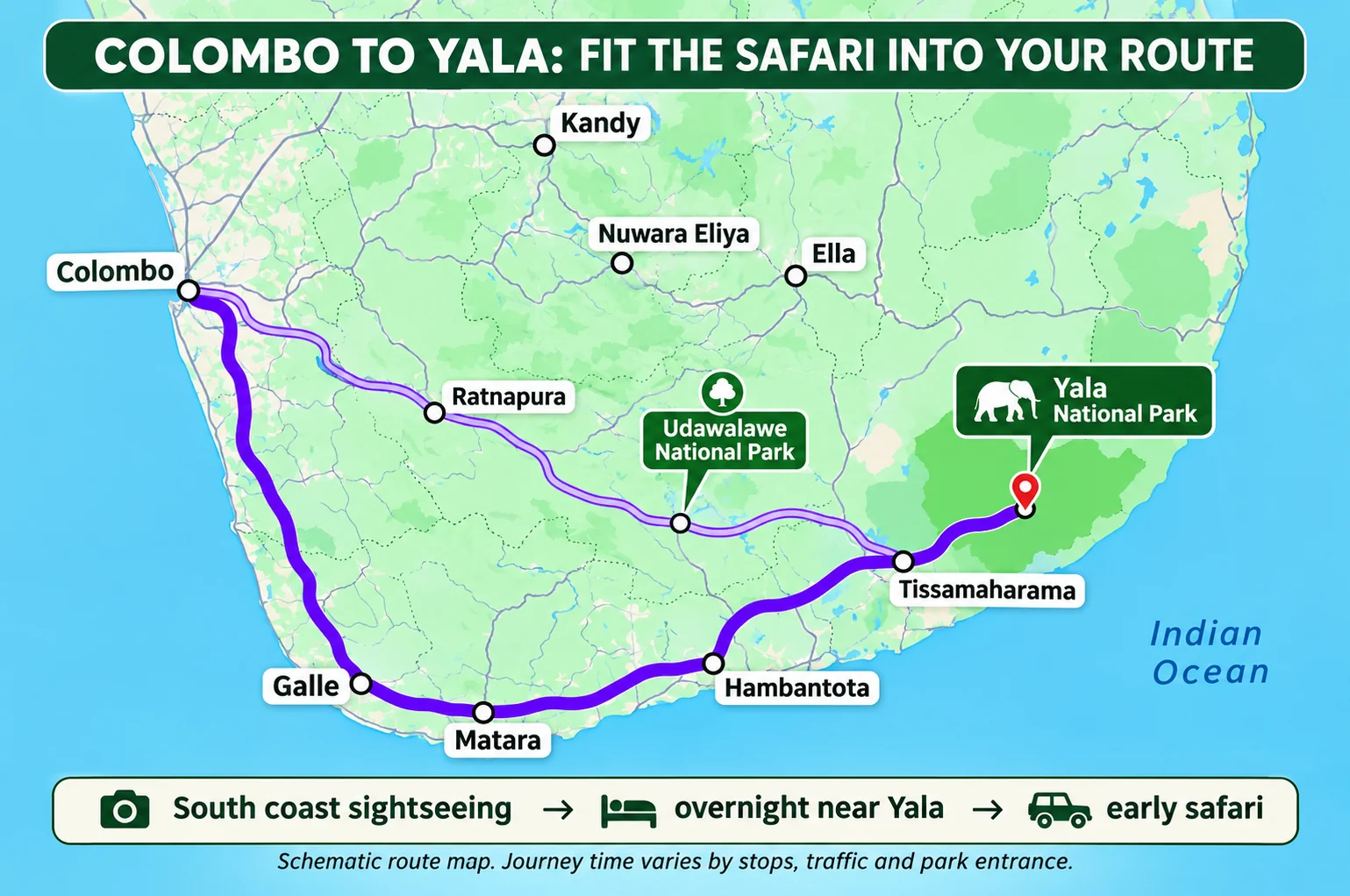
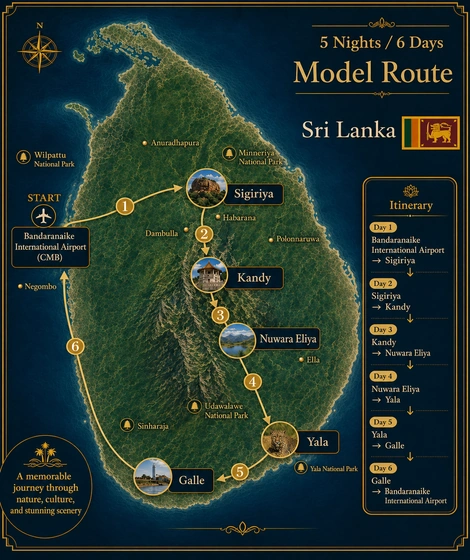
From Colombo, one option is to visit Galle or the southern coast, then stay near Yala before an early game drive. Afterwards, allow time to rest, stay another night near the park or continue towards Ella if the overall day is realistic. In the opposite direction, travellers can descend from Ella or the hill country, overnight near Yala, then continue towards Mirissa, Hikkaduwa or another beach base after the safari.
Udawalawe safari: elephants in open grassland
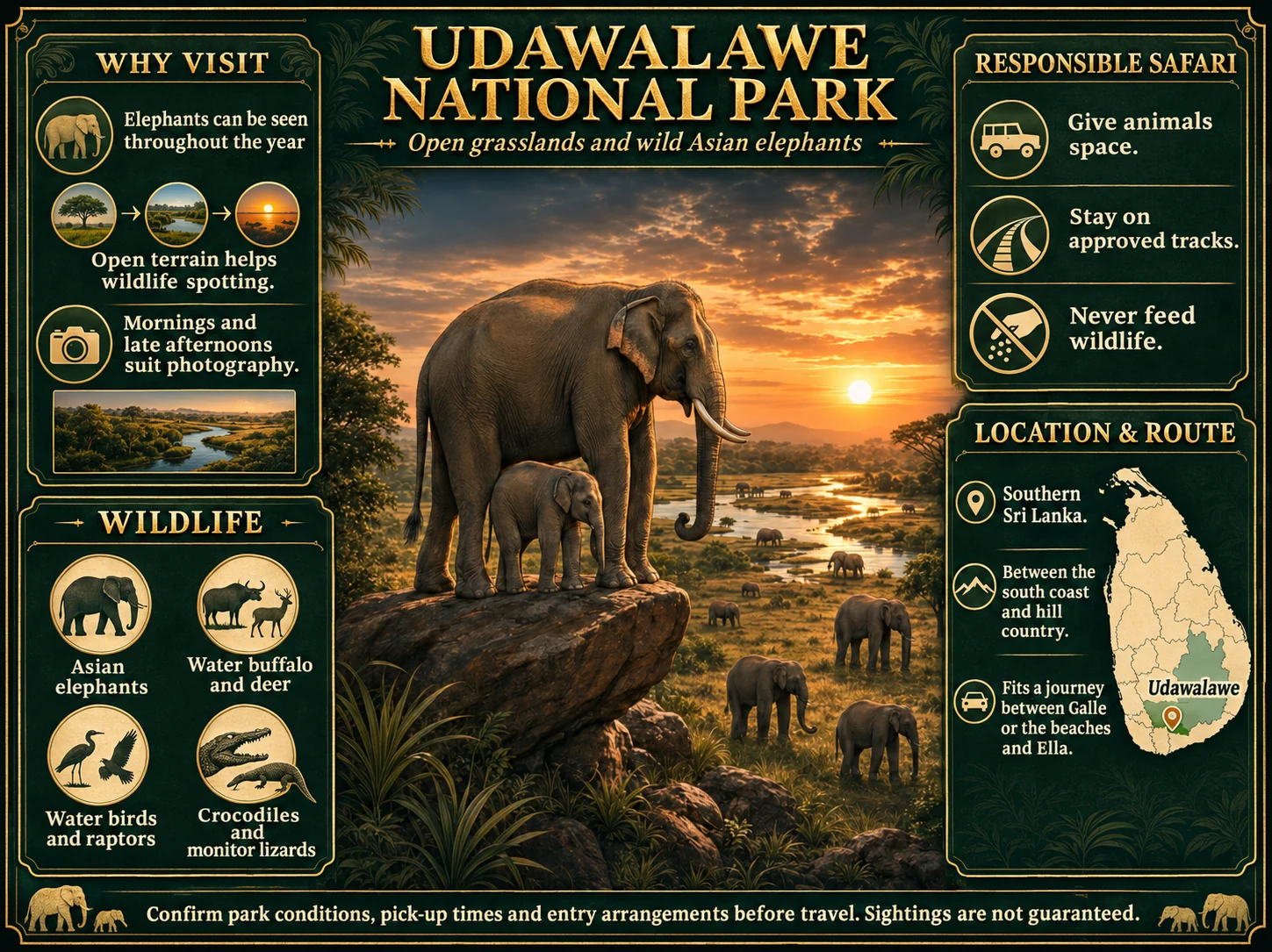
Udawalawe is a strong choice when seeing wild Asian elephants is the main purpose of the safari. The reservoir, surrounding grassland, scrub and river habitats support elephants throughout the year. The open terrain can make it easier to spot a herd and follow its behaviour than in a dense forest landscape, although animals are still free-ranging and sightings cannot be guaranteed.
The scenery is part of its appeal. Elephants feeding on the plains, birds around the water and distant hills give photographers several kinds of view. Morning and late afternoon are especially appealing for the softer light and more comfortable temperatures. Late light can also bring warm backdrops to the reservoir and grasslands.
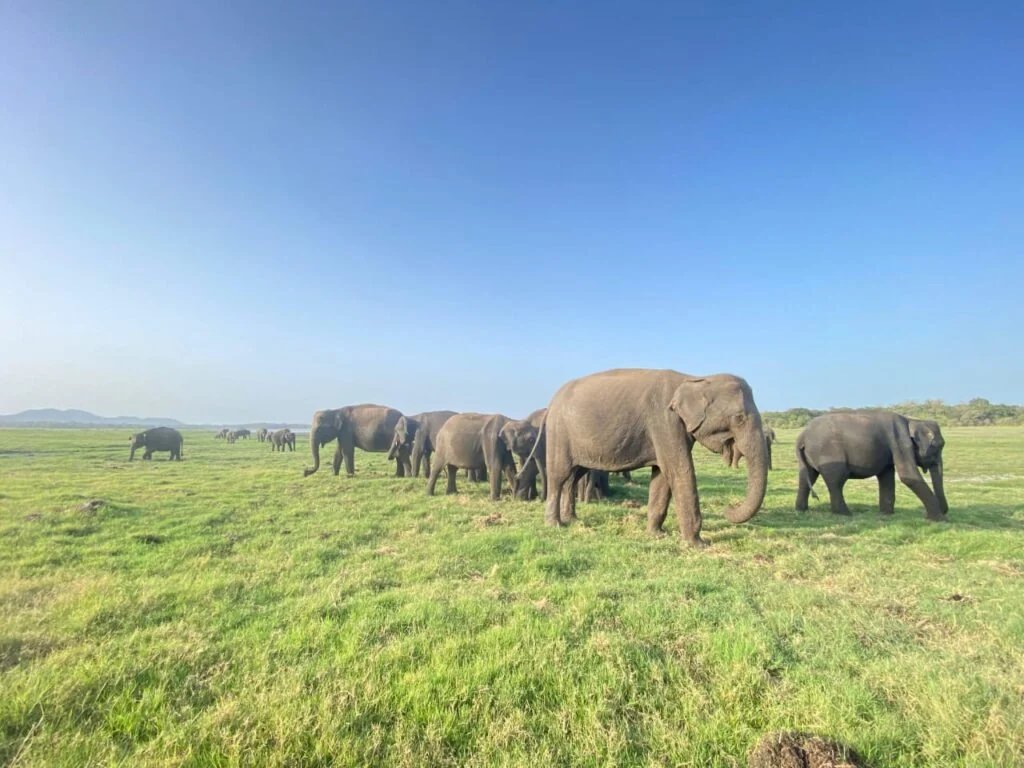
There is more to watch than elephants. Water buffalo, deer, birds of prey, wetland birds, crocodiles and monitor lizards add variety. Sri Lanka Tourism records 184 bird species, 43 mammals and 33 reptiles for the park.
Udawalawe works well between the south coast and the hill country. You might approach from Galle or a beach hotel, take a morning or afternoon safari, and continue towards Ella; the reverse route also works. Hotel location and the length of the game drive determine whether an overnight stay is preferable to adding another long road journey on the same day.
For families and first-time safari visitors, a half-day outing can be a manageable introduction. Tell us the children’s ages and any concerns about heat, dust, bumpy tracks or sitting for long periods. Give elephants space when they approach a track and follow the jeep driver’s instructions throughout.
Wilpattu safari: natural lakes, leopards and sloth bears
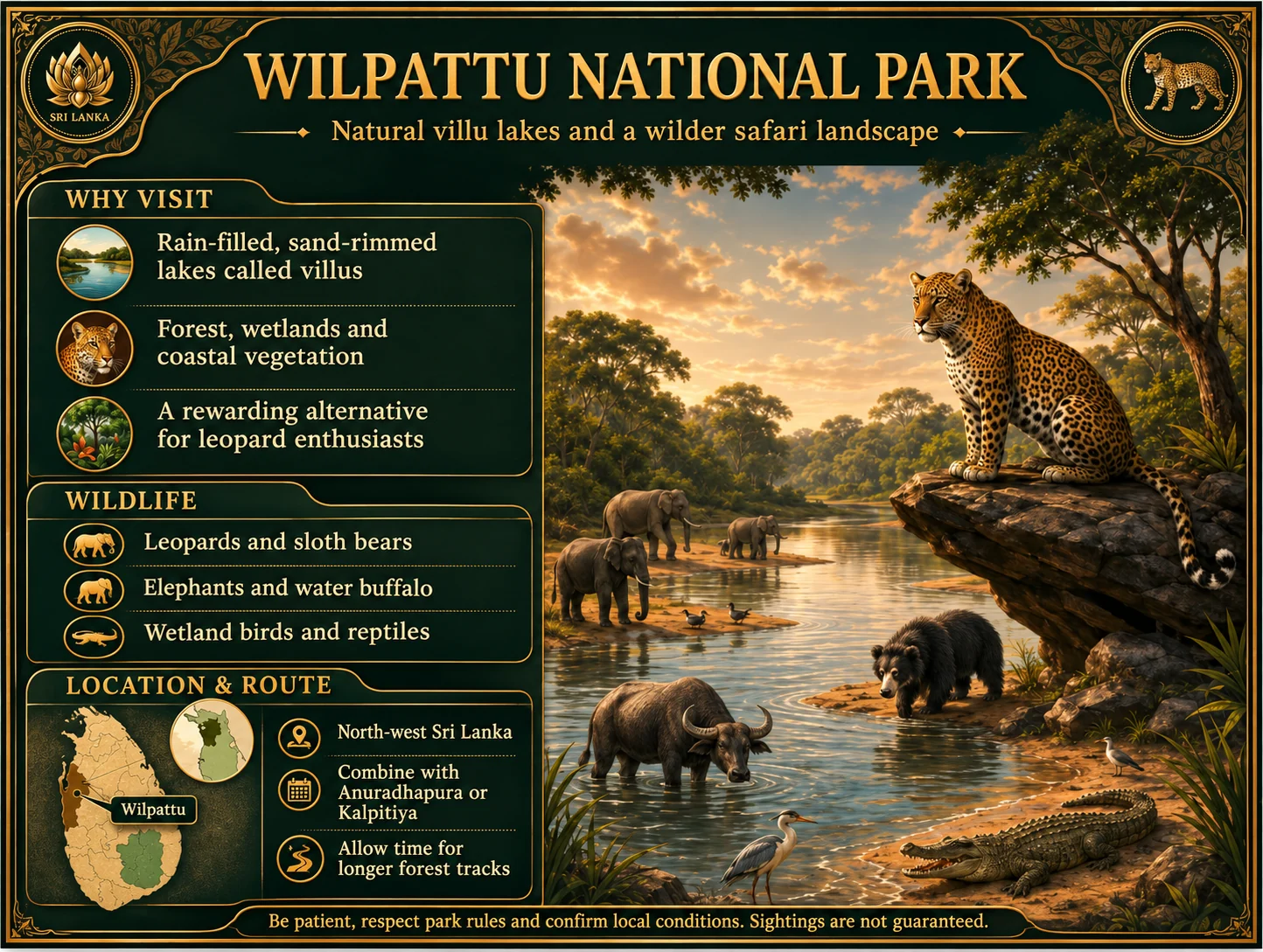
Wilpattu lies in Sri Lanka’s north-western lowland dry zone and fits routes around Anuradhapura and Kalpitiya. Its defining feature is the villu: a natural, often sand-rimmed basin that fills with rainwater. These lakes and wetland edges create a different atmosphere from the more open elephant country of Udawalawe.
Forest tracks can open suddenly onto a quiet body of water. That change of habitat is part of the pleasure of a Wilpattu safari: you can watch birds and reptiles around a lake, then move through woodland where deer or a leopard may be harder to see. Allow time for this slower rhythm instead of treating every stretch without a large mammal as wasted time.
Leopards and Sri Lankan sloth bears are among the park’s best-known residents. Elephants, water buffalo, spotted deer, sambar and smaller mammals also belong to its wildlife community. A sighting depends on the animals’ movements, vegetation and your route through the park; the driver’s experience helps with observation but does not remove that uncertainty.
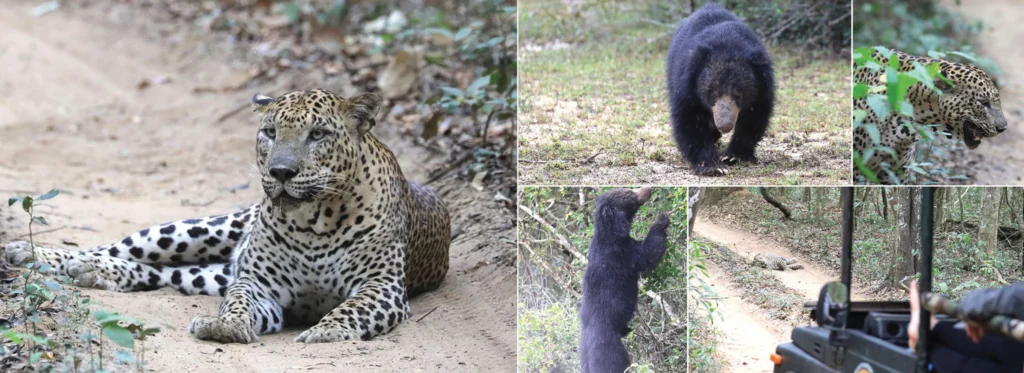
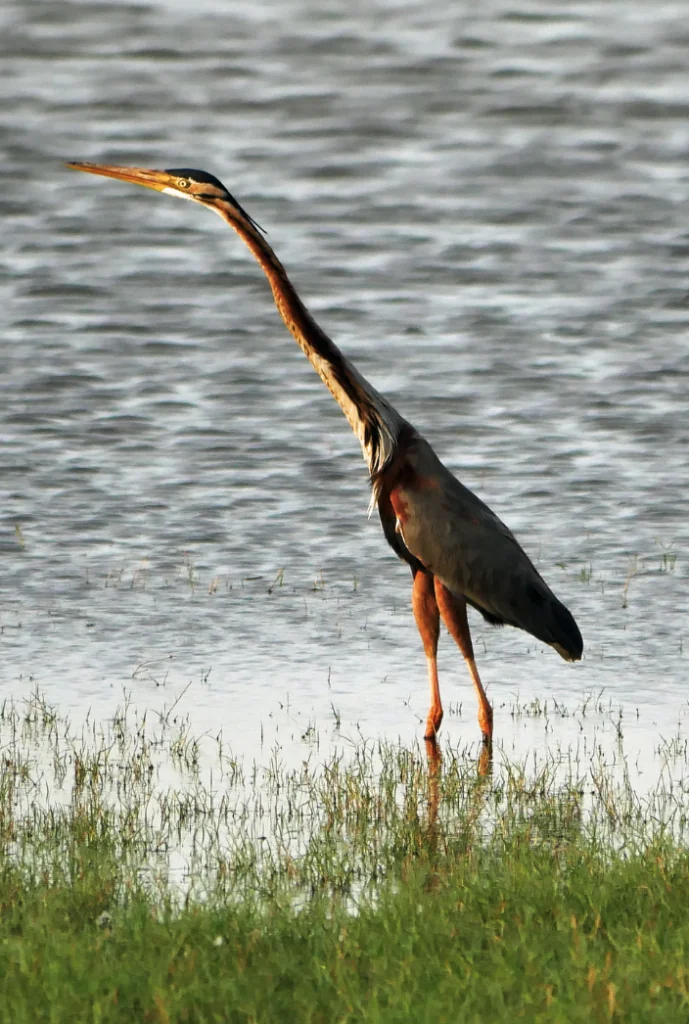
Wetland birds are another reason to bring binoculars. Storks, herons and other water birds use the villus, while monitors and crocodiles can be seen around the water. Sri Lanka Tourism records 31 mammal species and describes both coastal vegetation and monsoon forest, reflecting the park’s habitat variety.
From Anuradhapura, it is possible to plan the cultural visit and safari within the same northern part of the trip, but check transfer time to the actual gate. A morning game drive generally works better with a nearby overnight base. Wilpattu’s long forest tracks can reward a longer outing, so compare a half day with a full day according to your interest and comfort.
Minneriya safari: the elephant gathering near Sigiriya
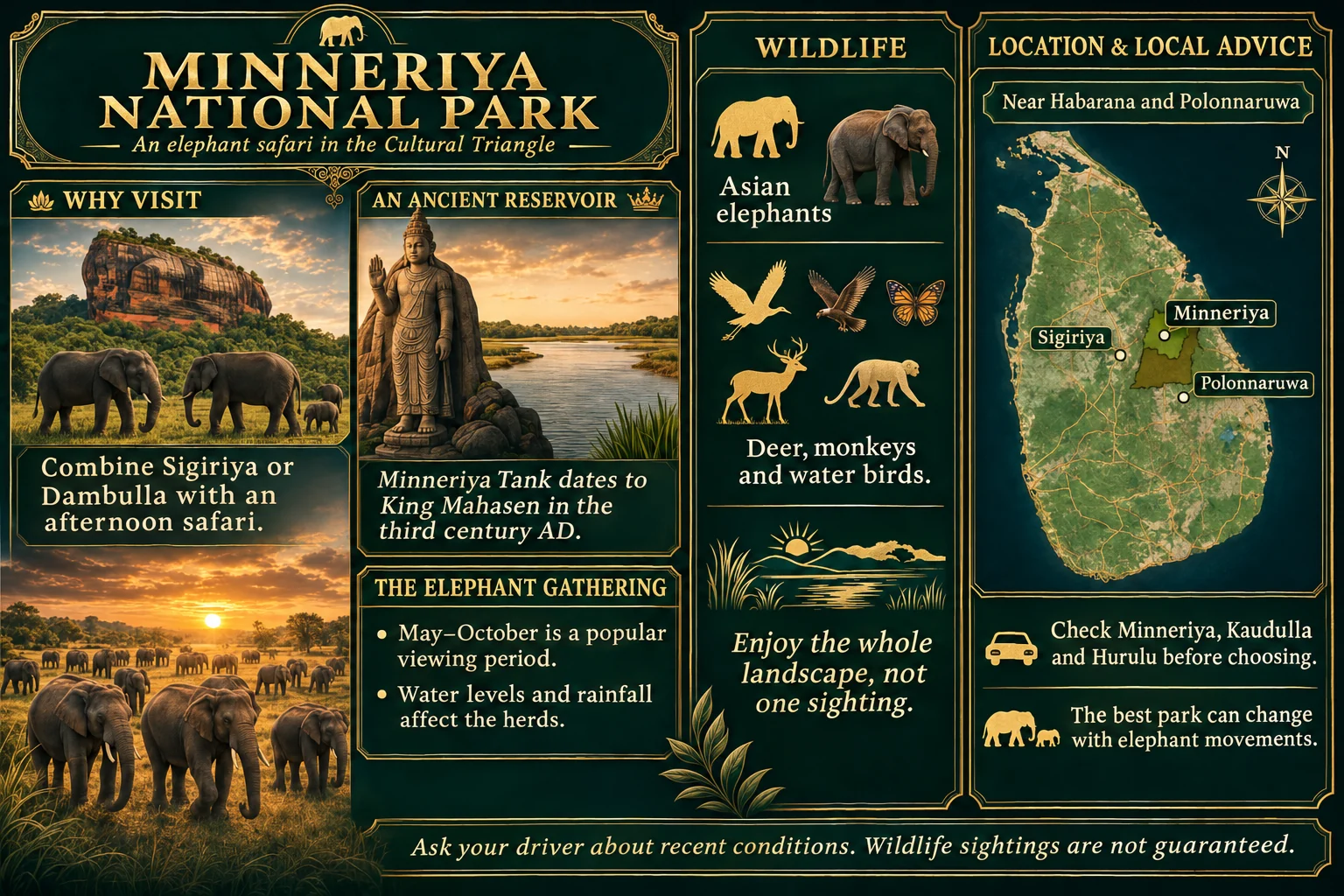
Minneriya is especially convenient for travellers based in Sigiriya, Dambulla or Habarana. It combines naturally with a Cultural Triangle itinerary: climb Sigiriya or Pidurangala earlier in the day, rest during the heat and plan an afternoon elephant safari. The precise journey time depends on your hotel, the chosen park and local conditions.
The park protects the catchment around an ancient irrigation reservoir. Minneriya Tank is associated with King Mahasen in the third century AD, so the setting links Sri Lanka’s wildlife with its long history of water management. It is an important reminder that the reservoir and surrounding habitat shape what you see on safari.
The famous elephant gathering happens as lower water levels expose fresh grazing around the reservoir. Herds move towards that food and water, sometimes bringing many animals into the same landscape. Sri Lanka Tourism identifies May to October as a popular period, but rainfall and water levels affect the timing and scale from one year to the next.
Outside the main gathering period, the region still offers wildlife and dry-zone scenery. Deer, monkeys and birds add interest, and reservoir margins are worth watching even when the elephants are more dispersed. Avoid judging the outing solely by the largest herd photograph you have seen online.
Minneriya, Kaudulla or Hurulu Eco Park?
These should be treated as alternative options to discuss, rather than three parks that deliver the same sighting every day. Elephants move in response to water, food and conditions, so the best viewing location can change. Ask the local driver team to check recent information before confirming the park and departure time.
LankaMe can help fit the chosen safari around your morning sightseeing, hotel and next destination. Patient observation and responsible distance matter whichever option is selected.
How to choose the right safari for your itinerary
For a holiday concentrated around Sigiriya and Dambulla, start with a locally recommended elephant safari in the Minneriya–Kaudulla–Hurulu area. On a route between Ella and the southern beaches, compare Udawalawe for elephants with Yala for varied habitats and the possibility of leopards. On a north-western route, Wilpattu can be a better fit than a long detour south.
European travellers combining a two-week round trip with several beach nights should leave space between the wildlife day and a long onward transfer. An early start, several hours in a jeep and another substantial drive can be tiring. Two well-chosen parks with different habitats may offer more variety than repeatedly searching for the same animal in one place.
Half-day or full-day Sri Lanka safari tour?
Choosing between 3–4 hours and 6–8 hours
A half-day safari is approximately 3–4 hours; the full-day guide is approximately 6–8 hours. Add travel between your hotel and the park. A half day can be easier to combine with a transfer or to manage with younger children, while a longer outing gives more time for patient observation and different parts of the park.
A full day also means more heat, dust, bumpy driving and time seated in the jeep. Check rest arrangements, meals, water and the practical schedule before choosing.
Compare entrance fees, jeep costs and hotel collection
The LankaMe table includes admission. When comparing another offer, establish whether the price is per person or for the group, whether the jeep is private, which entrance fee applies and where collection starts. A jeep-only rate is a different product from a group total that includes admission and coordinated arrangements.
Your confirmed quotation should state the park, group size, approximate duration, collection and return points, and any meals or extras. Tell us if your hotel is outside the usual park area or you are continuing to another town afterwards. Keep long-distance road transport separate from the safari-jeep element when comparing inclusions.
Yala, Udawalawe or an elephant safari near Sigiriya?
Choose in the context of the whole journey. Yala is a common first consideration for leopard hopes; Udawalawe suits an elephant priority; the Sigiriya-area parks are convenient for a Cultural Triangle stay; and Wilpattu brings a different forest-and-lake landscape on a north-western route. Confirm access and recent conditions before departure.
Safari planning tips
- Clothing and light
Wear comfortable, breathable clothing. Bring a light layer for an early start, a hat and sun protection. - Water and personal comfort
Carry drinking water and tell the team about mobility needs or concerns about rough tracks before booking. - Wildlife photography
Bring charged batteries, spare storage and binoculars if available. Protect equipment from dust and rain. - Responsible viewing
Do not feed, call to or chase animals. Keep litter in the vehicle and follow the driver’s safety instructions.
Arrange popular dates early and share children’s ages when enquiring, as admission conditions and practical needs can vary. Comprehensive travel insurance should cover your planned activities; travellers from Europe should check their own policy wording and current home-country travel advice rather than assuming a standard policy covers every activity.
Plan your Sri Lanka safari with a private driver
Sri Lanka’s safari parks reward different kinds of interest: elephant behaviour, the possibility of a leopard, birds around a lake or the changing light across open country. The best plan joins those interests to a realistic route, suitable accommodation and responsible local jeep arrangements.
LankaMe can coordinate the safari with your private car-and-driver journey. Share your dates, group size, hotel areas, preferred duration and wildlife priorities so we can discuss the practical options. The driver’s language, accompaniment and sightseeing assistance depend on your selected plan and confirmed arrangements.
Ready to include a safari in your Sri Lanka holiday?
Tell us where you are staying and what you hope to see. We can help match the jeep, park and timing to the rest of your route.
Request a safari quote →Read traveller reviews →References
- Wildlife park permits: official DWC reservation service
- DWC: how to reserve a day-visitor ePermit
- SLTDA: vehicle safari operation guidelines
- Sri Lanka Tourism: Yala National Park
- Sri Lanka Tourism: Udawalawe National Park
- Sri Lanka Tourism: Wilpattu National Park
- Sri Lanka Tourism: Minneriya National Park



Comments