
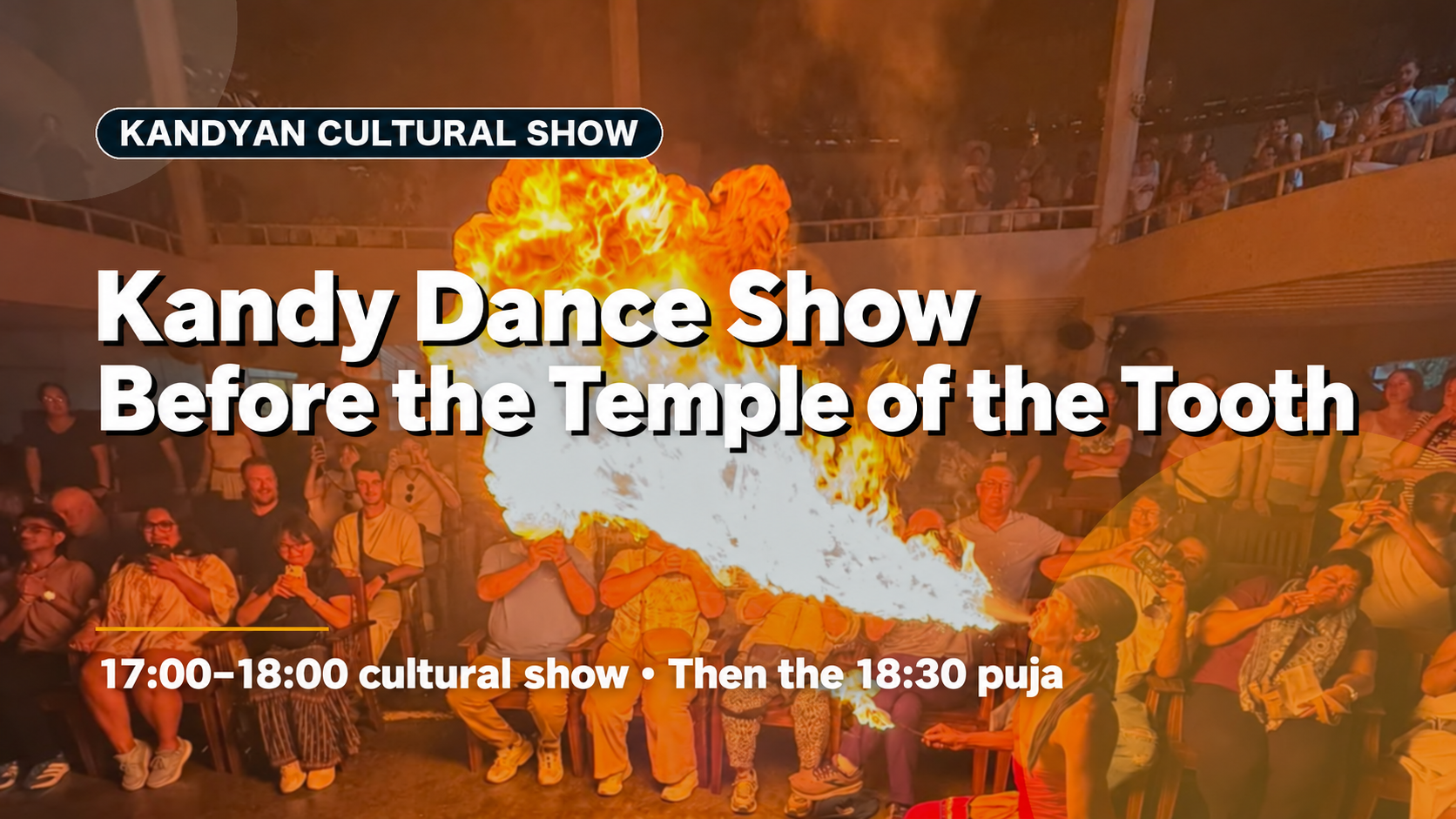
Watch Kandyan dance before visiting the Temple of the Tooth
Enjoy the 17:00–18:00 cultural show, then head to the Temple of the Tooth for the evening puja at around 18:30.
If you are deciding how to spend an evening in Kandy, consider the Kandyan cultural show at Kandyan Cultural Centre.
The venue is within walking distance of the Temple of the Tooth. With the show running from 17:00 to 18:00 and the temple’s evening puja beginning at around 18:30, the two visits fit together well.

Kandyan Cultural Centre: essential information
| Item | Details | What to know |
|---|---|---|
| Venue | Kandyan Cultural Centre | Within walking distance of the Temple of the Tooth; easy to combine with the lake area. |
| Show time | 17:00–18:00 | An hour-long performance that fits neatly into an evening itinerary. |
| Suggested order | Kandyan dance → Temple of the Tooth | Leave time to reach the temple for the puja at around 18:30. |
| Programme | Kandyan, folk and masked dances, drumming and fire acts | A visitor-oriented overview of several Sri Lankan performing traditions. |
Times and programmes can change. Confirm the day’s performance and temple arrangements before your visit.
Walking between the show and the Temple of the Tooth
Kandyan Cultural Centre is close to the Temple of the Tooth, so walking between the two is straightforward. Allow approximately 5–10 minutes, depending on crowds and the entrance you use.
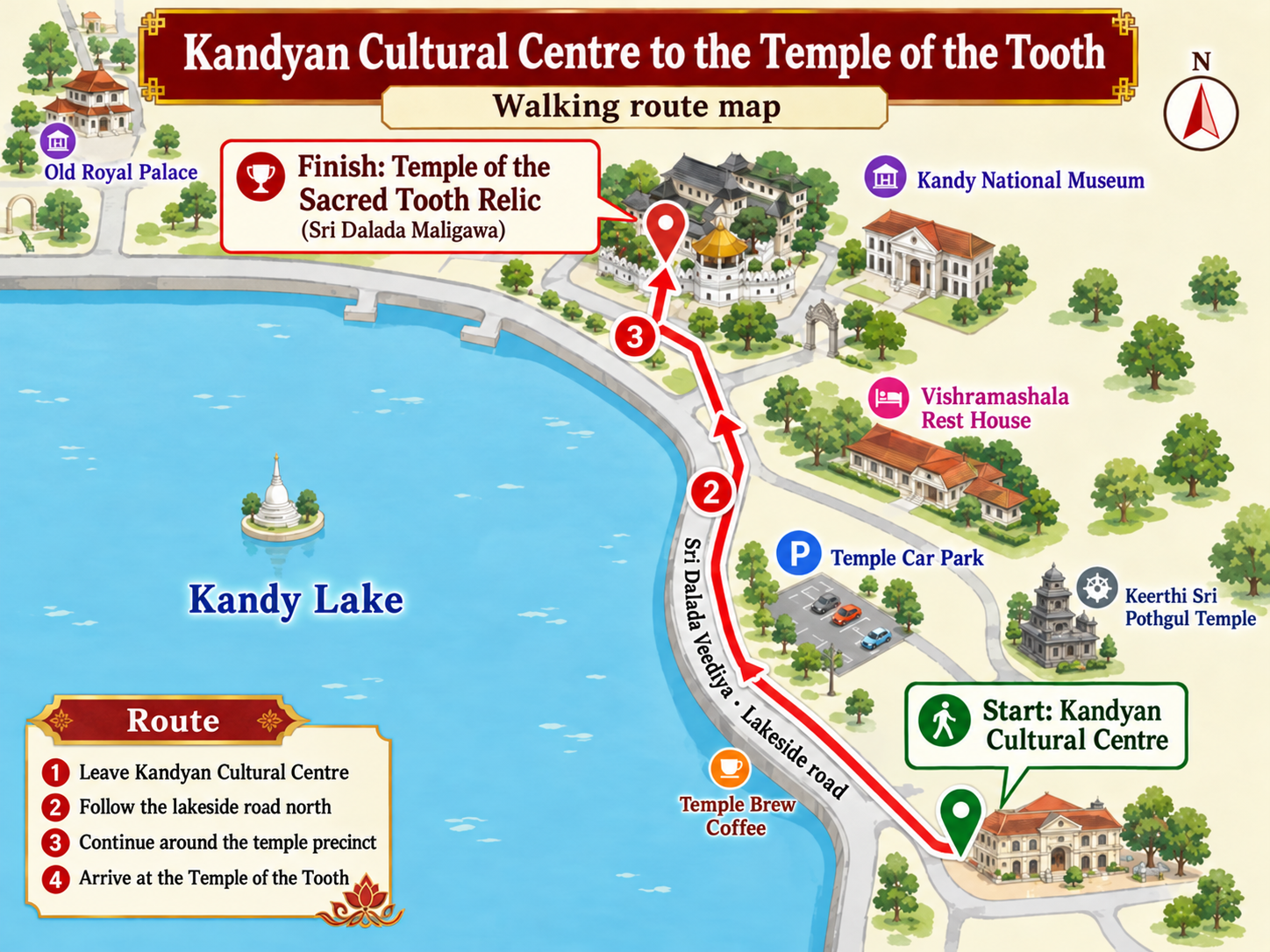
Many spectators leave at the same time. If you are continuing to the puja, finish any photographs or toilet stops promptly and allow a little extra time to walk over.
What is included in the Kandyan cultural show?
Despite its name, this is more than a performance of Kandyan dance alone. It combines dances from the Kandy region with village folk dances, southern masked dances and fire-based ritual performances in a programme designed for visitors.
Programme leaflets can be difficult to interpret in translation. The following guide explains the cultural background as well as what to look for on stage.


| No. | Act | Highlights |
|---|---|---|
| 1 | Magul Bera | Ceremonial opening drums |
| 2 | Puja Natuma | A dance of offering |
| 3 | Naga Gurulu | The cobra and the mythical bird |
| 4 | Raban Natuma | The hand-drum dance |
| 5 | Goyam Natuma | The rice-harvest dance |
| 6 | Pantheru Natuma | Dance with a tambourine-like instrument |
| 7 | Salu Paliya | A comic masked dance with a shawl |
| 8 | Mayura Natuma | The peacock dance |
| 9 | Gini Sisila | The fire dance |
| 10 | Ves Natuma | The heart of Kandyan dance |
| 11 | Drum orchestra | An ensemble of traditional percussion |
| 12 | Fire walking | A finale expressing faith and resolve |
A guide to the dances and performances
The programme generally follows this sequence:
- Ceremonial drums and offerings
- Mythological, village, warrior and masked dances
- Peacock dance and fire acts
- The classical Ves dance
- A percussion ensemble
- A fire-walking finale
1. Magul Bera
Ceremonial opening drums
A conch and drums announce the start of the performance. In Sri Lanka, drumming accompanies the opening of important ceremonies and festivals, invoking blessings and a successful occasion. Think of this as a ceremonial introduction that prepares the space and welcomes good fortune.
2. Puja Natuma
A dance of offering
Female dancers carry oil lamps and offer prayers to guardian deities, the Buddhist Triple Gem and the Sacred Tooth Relic. ‘Puja’ refers to worship or an offering, while ‘natuma’ means dance. This calm, graceful opening expresses wishes for the audience’s safety and well-being.
3. Naga Gurulu
The cobra and the mythical bird
Naga represents a cobra or serpent deity; Gurulu is a great mythical bird that captures snakes. Movement and masks portray their relationship. The act draws on two symbolic beings found in Buddhist stories and Sri Lankan folklore.
4. Raban Natuma
The hand-drum dance
This folk dance uses a round handheld drum called the rabana. Male and female dancers beat, spin and pass the drums, showing rhythm, teamwork and acrobatic skill. Enjoy its lively combination of percussion and movement rather than looking for a single religious story.
5. Goyam Natuma
The rice-harvest dance
A village folk dance depicts women harvesting rice. The movements evoke cutting, bundling, threshing and winnowing the grain. It is a bright, gentle celebration of rural life and gratitude for a good harvest.
6. Pantheru Natuma
Dance with a tambourine-like instrument
Dancers hold a pantheruwa, a metal ring fitted with small jingling discs. To its tambourine-like sound they perform strong footwork, changing formations, turns and acrobatics. Cultural shows often present it as an expression of warriors’ courage; the tradition also has connections with devotion to the goddess Pattini and reverence for the Tooth Relic.
7. Salu Paliya
A comic masked dance with a shawl
A performer wears a white shawl and swings it while entertaining the audience with humorous movements. The dance comes from southern Sri Lankan healing and exorcism rituals, where laughter could soothe a patient’s fears and invite Pattini’s protection. Strictly speaking, it belongs to the southern low-country tradition rather than Kandyan dance.
8. Mayura Natuma
The peacock dance
Female dancers use graceful arm and body movements to evoke a peacock walking, fluttering and spreading its feathers. The peacock is the vehicle of the warrior god Skanda, worshipped in Sri Lanka as Kataragama. The dance therefore praises the deity and seeks blessings as well as celebrating the bird’s beauty.
9. Gini Sisila
The fire dance
This act incorporates southern traditions. Performers swing burning torches, bring them close to the body and may place them near or in the mouth, conveying mastery over fear. Its ritual background relates to protection from harmful spirits and misfortune and to the blessings of Kataragama.
10. Ves Natuma
The heart of Kandyan dance
This is a key performance to watch closely. Male dancers in sacred Ves costume, particularly the silver-coloured headdress, perform powerful jumps, turns, stamping and intricate rhythmic movements. The traditional costume is said to comprise 64 ornaments. The headdress is especially sacred and is traditionally worn by men who have completed years of training and the formal Ves Mangalya initiation ceremony.
11. Drum orchestra
An ensemble of traditional percussion
Several drums and percussion instruments layer contrasting rhythms. The appeal lies in the musicians’ exchanges, tempo changes and shifts in volume: an opportunity to appreciate the rhythms that support Kandyan dance. The geta bera is a representative drum of the Kandy region.
12. Fire walking
A finale expressing faith and resolve
At the end of the performance, artists walk barefoot across glowing embers. In Sri Lanka, fire walking is associated with devotion to Kataragama, vows, purification and prayers for healing; the cultural show recreates aspects of the ritual as a finale for spectators. Some leaflets also mention Sita’s trial by fire in the Ramayana. That story alone does not explain Sri Lankan fire walking, which is closely connected with the island’s own religious traditions.
Can you take photographs with the performers?
After the show, it may be possible to pose with the performers. Seeing the costumes close up makes a lovely souvenir, but a tip is commonly requested for photographs.
The amount is not necessarily large, but carrying small notes is useful if you plan to take a photo. If you prefer not to tip, there is no need to approach the performers; you can simply enjoy the atmosphere.


A rewarding hour before your temple visit
The 17:00–18:00 show at Kandyan Cultural Centre offers an hour of Sri Lankan performing arts that is easy to build into sightseeing in Kandy.
Our suggested order is the show followed by the Temple of the Tooth puja at around 18:30. Dance, drums, masks and fire create a vivid introduction to the city’s cultural atmosphere before the temple visit.
For accommodation after visiting the temple, our Kandy hotel guide is a useful next read.



コメント